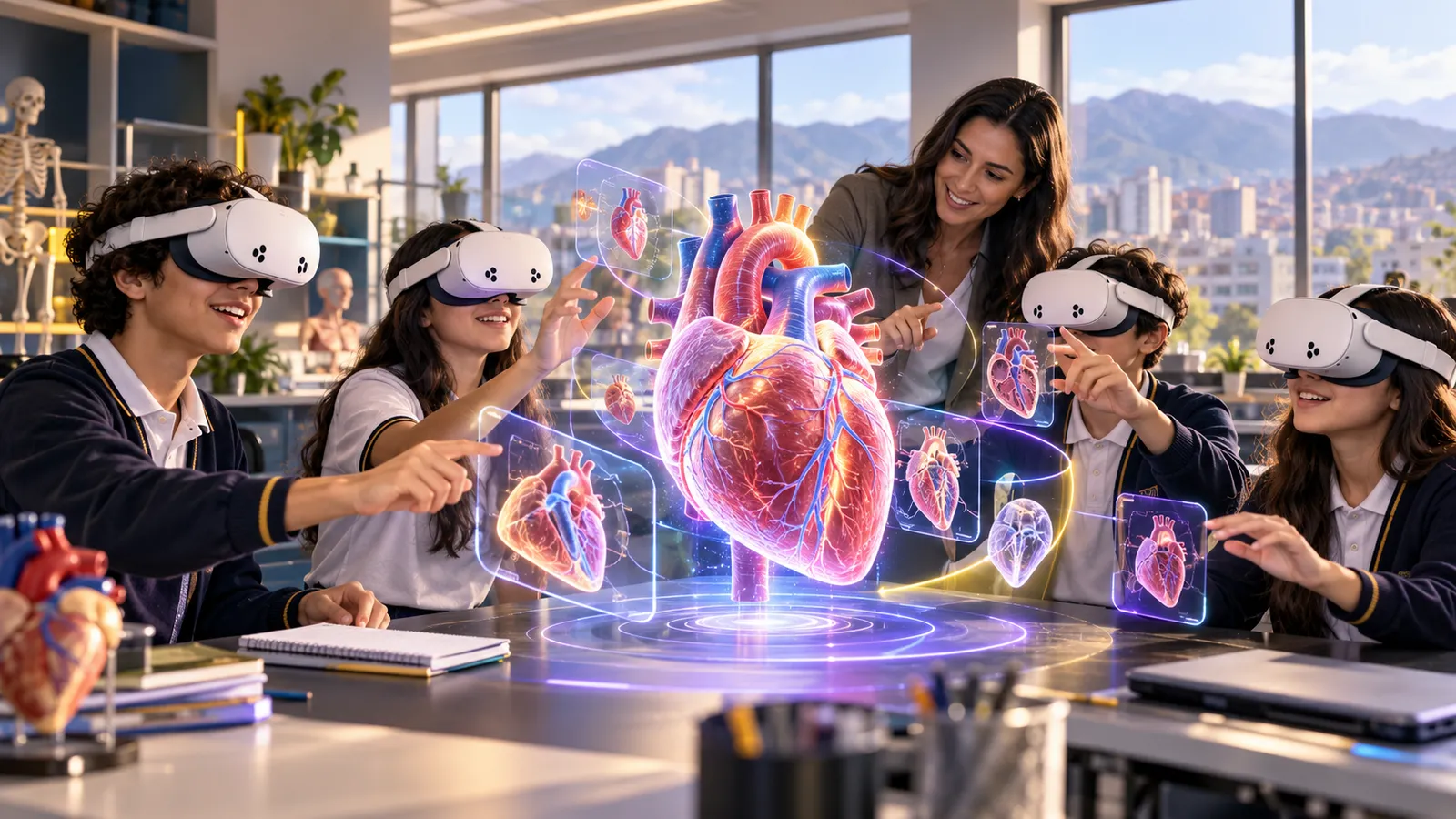
Yes: with PIXLAB 3D, a school can have an extended reality (XR) lab without a large upfront investment. It pays a monthly fee per student that includes Meta Quest headsets, more than 5,000 educational 3D objects, an artificial intelligence assistant, teacher training and technical support. Pixdea compares that fee to the cost of a textbook; the final price depends on the proposal for each school.
What if your school could offer virtual reality experiences, three-dimensional models and immersive labs without a large upfront investment?
For years, having advanced technology labs seemed like something only schools with large budgets could afford. Specialized equipment, facilities and maintenance were major barriers for many schools.
However, the evolution of educational technology is opening new ways to transform classrooms.
Today, with solutions like PIXLAB 3D, schools can explore an extended reality lab model that bundles devices, educational content and teacher support into a monthly fee per student.
How much does it cost to innovate in a school?
When a school considers modernizing its facilities, it usually thinks about lab equipment, computers, furniture and other specialized resources.
But what if that investment also let students explore the human body in three dimensions, travel virtually to historical settings or interact with scientific concepts?
Extended reality (XR) combines technologies such as virtual reality and augmented reality to offer new ways to visualize and explore content.
These experiences do not automatically replace a physical lab, but they can significantly complement the activities teachers run in class.
PIXLAB 3D: a lab designed to transform learning experiences
PIXLAB 3D is an extended reality lab developed by Pixdea that lets students touch knowledge through interactive educational content.
It includes:
- Meta Quest virtual reality headsets.
- More than 5,000 educational 3D objects.
- More than one million complementary educational resources.
- A built-in artificial intelligence assistant.
- Multiplayer experiences and custom spaces for schools.
- Teacher training and support.
- Technical support and content updates.
The goal is to give schools an environment where the teacher’s explanations can be complemented with visual, interactive exploration.
From studying a concept to exploring it
Imagine a natural science class.
The teacher introduces the circulatory system and explains how the heart works. Traditionally, they might rely on illustrations, slides or physical models.
With an XR lab, students can observe a three-dimensional model of the heart, analyze its structures and ask questions during the activity.
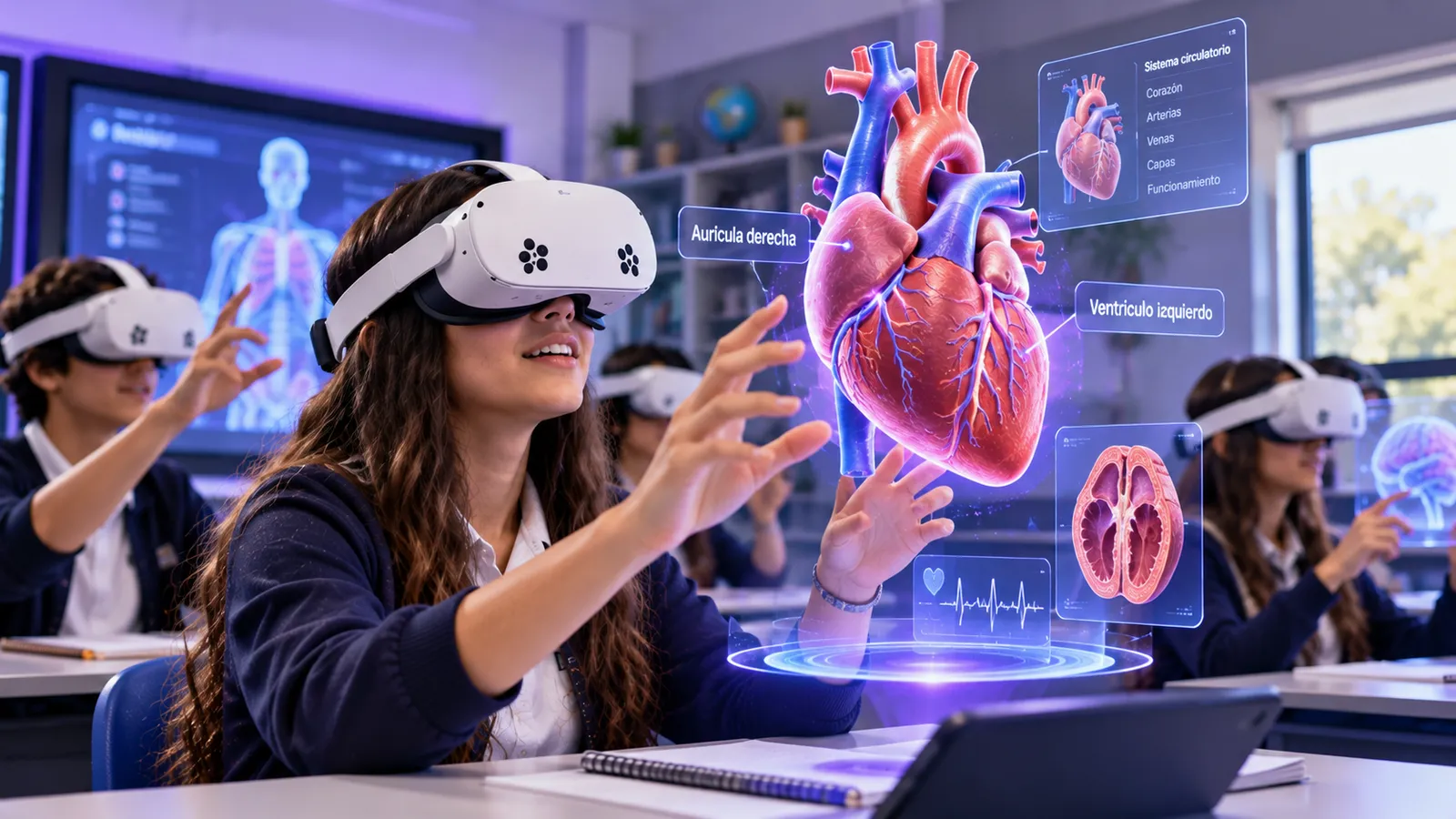
The difference is adding a visual, interactive experience to the teaching process.
This also opens possibilities in history, geography, biology and other areas of the curriculum.
Can schools access this technology without a large upfront investment?
PIXLAB 3D offers a business model based on a monthly fee per student that bundles hardware, software and support.
On its official website, Pixdea presents this offer by comparing it to the cost of a textbook. The exact amount depends on the commercial proposal for each school.
Beyond that comparison, the value lies in giving schools a way to plan the adoption of immersive technology without buying each component separately.
Educational innovation starts with an experience
Technology alone does not transform education. Its value depends on how teachers build it into their teaching strategies and on the opportunities it gives students.
That is why seeing a solution in a hands-on demo can be the first step to assess its potential in your school.
Is your school ready to explore new learning experiences?
Book your free PIXLAB 3D Demo Day and see how an XR lab works in a school setting.
Frequently asked questions
Does PIXLAB 3D include virtual reality headsets?
Yes. The PIXLAB 3D business model includes Meta Quest headsets along with access to the software, the library of 5,000+ educational 3D objects, teacher training and technical support. The school does not need to buy each component separately: everything is bundled into a monthly fee per student.
Do teachers need prior experience with virtual reality?
No. The offer includes initial training and ongoing support so teachers can bring the lab into their lessons. The headsets use hand tracking instead of complex controllers, and the AI assistant helps prepare lesson plans. Prior experience with virtual reality is not a requirement.
Does an XR lab replace traditional labs?
Not necessarily. An XR lab complements a school's physical resources: it lets students explore in three dimensions structures, places or processes that are hard to observe in the classroom, such as the inside of the heart or a historical setting. Its value depends on how each teacher builds it into their planning.